Strong Emphasis on Protection and Risk Reduction from DASK During Earthquake Week
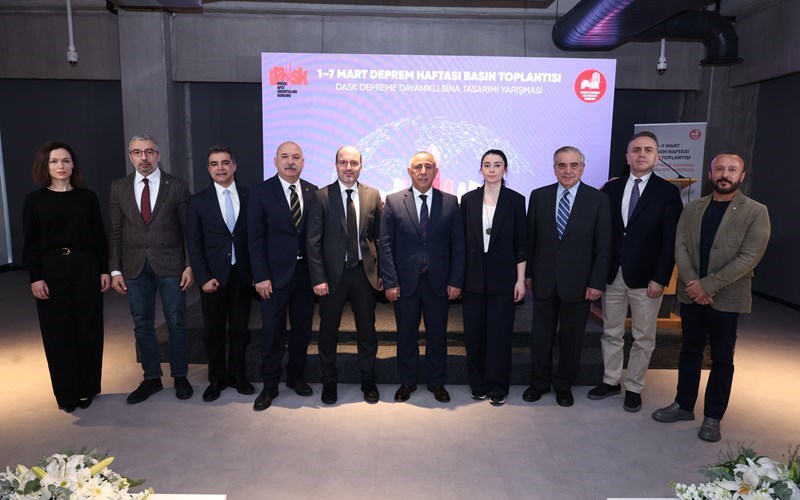
At the press conference it held as part of 1–7 March Earthquake Week, the Natural Catastrophe Insurance Pool (DASK) shared with the public Türkiye’s financial preparedness against earthquake risk and its engineering-based risk reduction approach.
The meeting, held at the Türk Reasürans campus, was attended by Mahmut Hersanlıoğlu, Deputy Governor of the Governorship of Istanbul (T.R.); Hande Akın, Chairman of the Board of DASK, and Board Member Şenol Şentürk; Özgür Bülent Koç, Acting General Manager of Türk Reasürans; Uğur Gülen, President, Insurance Association of Türkiye (TSB); Prof. Dr. Sinan Akkar, Chairman of the Board of the Turkish Earthquake Foundation; and Prof. Dr. Mustafa Erdik, Head of the DASK Earthquake-Resistant Building Design Competition.
At the meeting, it was emphasized that earthquake risk is not only a matter of physical destruction but also a test of the resilience of economic systems.
DASK Secretary General Balkır Demirkan stated that they do not view Earthquake Week merely as a calendar reminder and emphasized that, as a country living with the reality of earthquakes, preparedness levels must be continuously reviewed.
Emphasizing that, as an institution with more than a quarter century of experience, they continue with determination to strengthen the financial protection system against earthquake risk, Demirkan stated that 25 years of institutional memory and field experience form the foundation of operational capacity in times of crisis.
Demirkan stated that approximately 630,000 damage claims were received following the 6 February Kahramanmaraş earthquakes, adding that payments began within the first 24 hours after the notifications and saying, “This picture clearly demonstrated that our system functioned smoothly in times of crisis.”
Noting that there are approximately 12 million compulsory earthquake insurance policies across Türkiye, Demirkan emphasized that increasing the insurance penetration rate directly affects the speed of post-disaster recovery and stated:
“Our duty is not only to make payments at the time of loss but to be prepared before the risk materializes. For this reason, the continuity of insurance awareness and the uninterrupted renewal of policies are of great importance.”
“Domestic reinsurance capacity is not a choice but a strategic necessity”
Özgür Bülent Koç, Acting General Manager of Türk Reasürans, stated that the 6 February earthquakes were a major test not only physically but also for the financial system and commented as follows:
“We made compensation payments of approximately USD 1.6 billion. The total amount paid in DASK’s 25-year history is around USD 2 billion, of which USD 1.6 billion was paid during a single disaster period. This clearly demonstrates the system’s operational capacity, the effectiveness of the reinsurance program, and the resilience of our financial structure.”
Koç stated that natural disaster costs are rising rapidly on a global scale and that the increase in risks associated with climate change is driving up capacity costs in reinsurance markets. Noting that high-risk economies become more fragile during periods when global capacity tightens, Koç emphasized the strategic importance of domestic reinsurance capacity.
Stating that “domestic reinsurance capacity is not a choice but a strategic necessity,” Koç emphasized that strong national capacity plays a critical role in economic stability.
DASK Earthquake-Resistant Building Design Competition Is Becoming a Regional Platform
The meeting also shared the national and international scope of the DASK Earthquake-Resistant Building Design Competition, which is being held for the ninth time this year.
A total of 38 applications were submitted from 30 universities this year. Competition Chair Prof. Dr. Mustafa Erdik stated that invitations were sent to technical universities across a wide geography extending from the Mediterranean to the Balkans and from Central Asia to North Africa, adding that a total of 25 universities qualified for the grand final—4 from Kosovo, Azerbaijan, Greece, and Romania, and 21 from Türkiye. The finalist universities were announced to the public via the official website of the DASK Earthquake-Resistant Building Design Competition (https://binatasarimi.dask.gov.tr/) and its social media accounts.
Emphasizing that earthquake safety is determined at the design stage rather than during the construction process, Erdik commented as follows:
“We cannot prevent earthquakes. However, with scientific data, proper design, and a performance-based engineering approach, we can significantly reduce losses. Earthquake safety begins not at the construction site but at the design table.”
Organized this year under the theme “We Find Confidence in Engineering and Strength in Solidarity,” the competition has evolved beyond being merely a model design event into a platform that strengthens knowledge sharing and academic interaction in the field of earthquake engineering.
The final event of the competition will be held on 13–14–15 May 2026 at the Ottoman Archives (Osmanlı Arşivleri) in Istanbul. Teams will test their scaled building models on a shaking table and will be evaluated according to performance criteria.